6 Questions to Ask Before Starting a Competitive Intelligence Project
Competitive Intelligence (CI) can look very different depending on the need. Sometimes it’s a quick fact-check. Sometimes it’s a 1,000-person survey with models and dashboards. It can be a one-page battlecard for sales, or a board-level deck shaping the company’s five-year roadmap.
Like most research, CI starts with a question. From there, you collect and analyze information, apply methods, and produce actionable insights that drive decisions.
Why take a structured approach? Because without it, CI efforts get scattered fast. Teams end up drowning in data, chasing shiny competitor moves, or producing outputs no one uses. A clear framework keeps you focused on the real problem, aligns stakeholders, and makes sure the deliverable actually influences decisions. In short: structure turns research into business value.
The six questions below will help you frame your CI effort in a way that makes it constructive and useful. Answering them clarifies scope, shape, and deliverables before you even start.
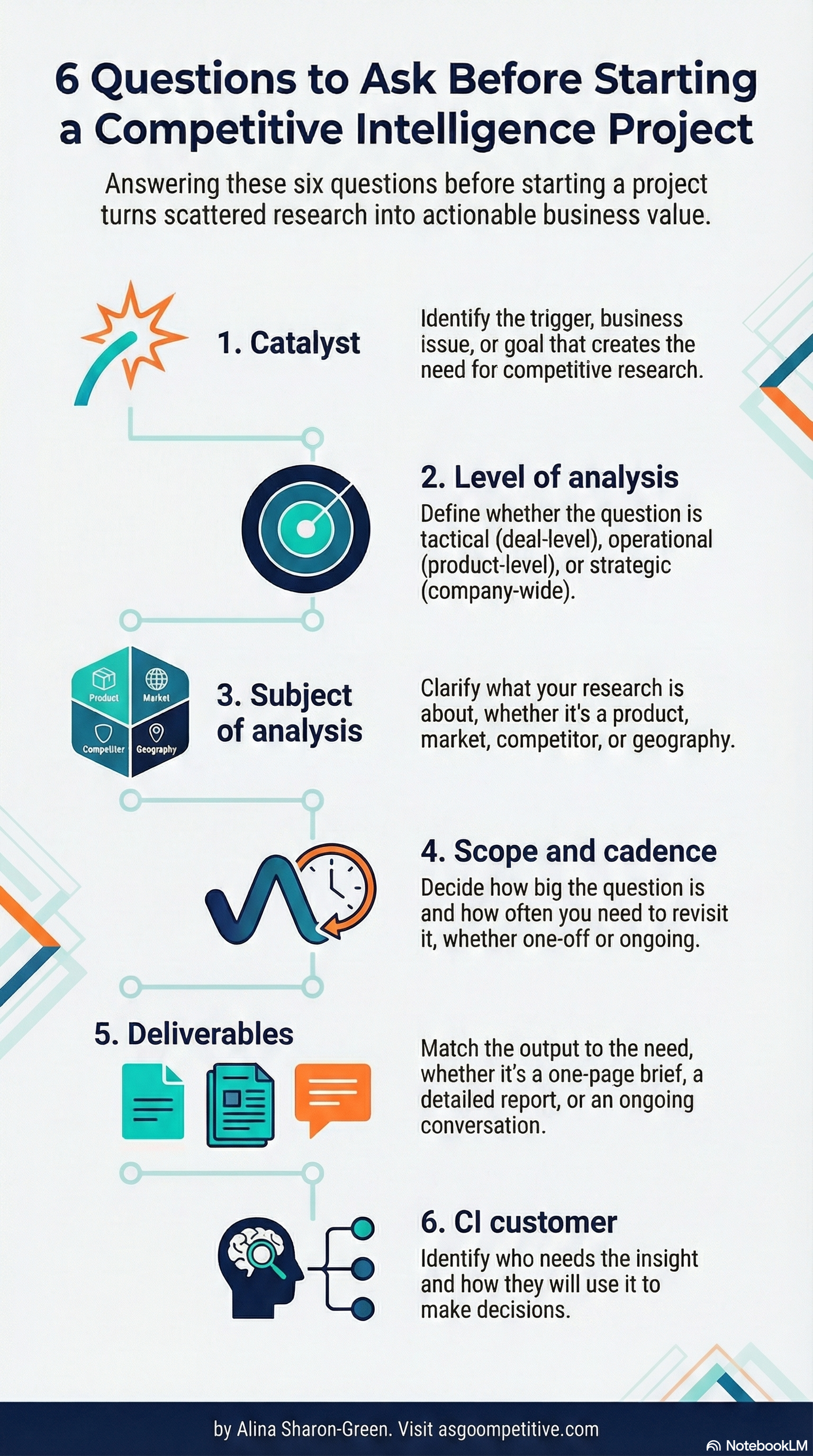
1. Catalyst (Why are we doing this?)
The trigger that creates the need for competitive research. It might be:
A business issue.
A business goal.
Previous insight raising new questions.
Examples:
Sales is losing deals to a competitor but doesn’t know why.
The company wants to enter Germany next year and needs to understand the market.
A rival is hiring data scientists, suggesting new capabilities are coming.
2. Level of analysis
Define whether the question is:
Tactical (deal or account level).
Operational (product or business unit).
Strategic (company-wide or portfolio).
Examples:
Supporting sales on a major deal against top competition (tactical).
Product managers want to benchmark features (operational).
Leadership wants a market map to guide an acquisition (strategic).
3. Subject of analysis
Clarify what your research is about:
A product.
A market.
A competitor.
A person.
A geography.
Examples:
Analyzing a competitor’s pricing model.
Exploring AI adoption in fintech.
Profiling the C-suite of a company with partnering potential.
4. Scope and cadence
Decide how big the question is and how often you need to revisit it.
Scope: large or small?
Cadence: one-off or ongoing?
Examples:
Confirming if a competitor launched a specific feature (small scope).
Mapping all players in an emerging market (large scope).
Monitoring competitor funding rounds monthly (ongoing cadence).
5. Deliverables
Match the output to the need. Deliverables can be:
A yes/no answer.
A brief (short deck or doc).
An ongoing conversation (as part of a planning, ideation, discovery, or brainstorming process).
A long-form report.
Examples:
Sales wants a one-page cheat sheet.
The CMO may want a 30-page report to guide campaign strategy.
6. CI customer (Who is this for?)
Identify who needs the insight and how they will use it.
Examples:
Sales reps need short, practical outputs.
Product managers want benchmarking to guide the roadmap.
Executives want big-picture trends and implications.
Wrapping up
Every CI effort should answer these six questions. Together, they determine the tools, sources, and analysis you’ll apply — and how the final insights, recommendations, and options will be delivered.
The real benefit of this structure: it keeps you from wasting time on scattered research. Instead, it forces clarity up front, aligns the team on what matters, and ensures your work actually drives decisions. CI done this way is lean, focused, and useful — not just another report collecting dust.
Starting a competitive intelligence project and want to get it right from the start?
I run hands-on workshops and mentoring sessions to help teams frame the right CI questions, define scope, and design research that leads to clear decisions.
