
3 Simple Competitive Analysis Frameworks to Use in Your CI Strategy
SWOT, Porter's Five Forces, and the 2×2 matrix — with a CI-focused perspective that turns them into real decision-support tools.
Frameworks are practical tools: templates and how-tos that help organize thinking, guide analysis, and visualize results. They are building blocks for creating a strong competitive analysis and improving your competitive intelligence strategy.
To bring Competitive Intelligence (CI) down to the practical level, here are three well-known frameworks. Many of you may already use them, but I’ll add a CI-focused perspective that makes them more actionable.
1. The SWOT Framework
Strengths, Weaknesses, Opportunities, Threats
Though common in strategic planning, SWOT can be applied to almost anything: a company, product, feature, or even a decision. Its flexibility makes it powerful, but also easy to misuse.
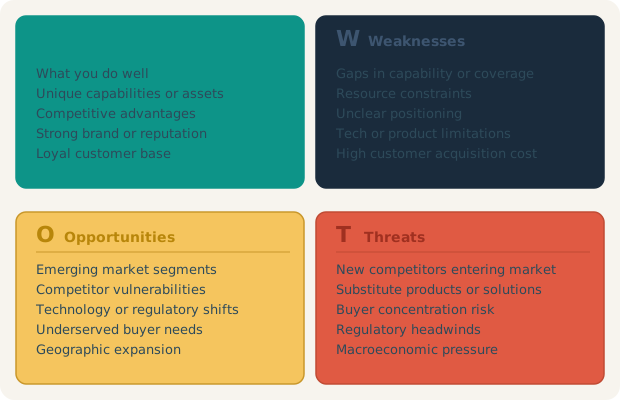
Ground Rules for a Competitive SWOT
- Base it on facts and data. Inputting hopes or marketing spin reduces its value.
- Keep each point short and focused. A few bullets per quadrant is enough.
- Ensure alignment across quadrants. If strengths and weaknesses relate to a product, so should threats and opportunities.
- Distinguish carefully: strengths and weaknesses are internal characteristics, while opportunities and threats are external factors.
- If opportunities and threats are not relevant, focus just on strengths and weaknesses.
Using SWOT in Competitive Analysis
For CI, SWOT helps assess a competitor’s situation, positioning, and likely strategy. The opportunities and threats quadrants provide insight into possible future moves.
Tips for constructing a competitive SWOT:
- Define scope clearly: company, product, feature, or technology.
- Stay consistent in focus (do not mix tactical and strategic).
- Cover all aspects: pricing, go-to-market (GTM), support, regulation, supply chain, not just tech.
- View the analysis from the competitor’s perspective, not your own.
- End with recommendations or action items. Translate insight into action.
- Treat it as a living document. Revisit and update with new information.
2. Porter’s Five Forces Framework
Originally designed as a competitive framework, it analyzes the five main forces that shape a company’s competitive environment:
- Competitive rivalry (existing competitors)
- Threat of new entrants
- Threat of substitutes
- Bargaining power of suppliers
- Bargaining power of customers
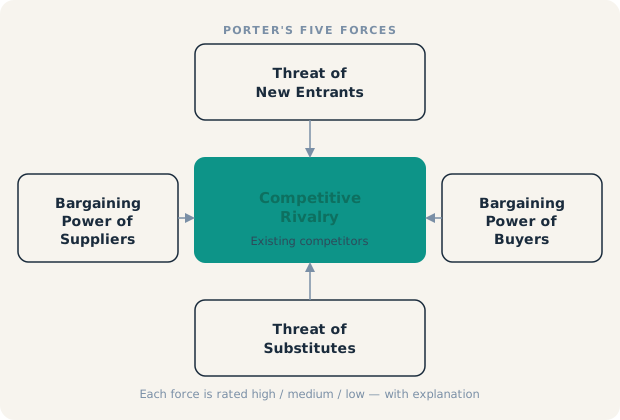
This is a qualitative model: each force is rated high, medium, or low, with explanation.
CI Perspective
Its value lies in pushing you to look beyond direct competitors:
- Substitutes can be as threatening as rivals (for example, mobile phones vs. digital cameras).
- Suppliers matter as much as customers. Strong supply chains and reliable partners can be decisive.
The model has evolved, including a Sixth Force (complementary products). While not perfect for every industry, it remains a powerful reminder to broaden your market analysis.
3. The 2-by-2 Matrix
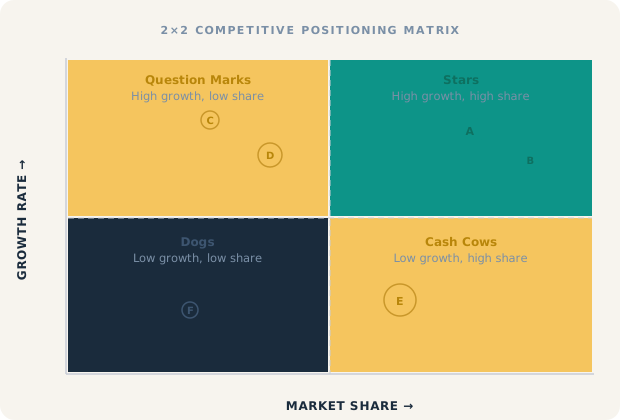
Deceptively simple, the 2x2 matrix is one of the most versatile frameworks. It visualizes complex data in a clear way, making it a favorite for both analysis and presentation.
Famous examples include:
- SWOT itself
- BCG Matrix (market share vs. growth rate)
- Gartner Magic Quadrant (completeness of vision vs. ability to execute)
CI Applications
In Competitive Intelligence, 2x2s can:
- Map the competitive landscape using two key attributes (price vs. performance, revenue vs. market share, etc.)
- Prioritize competitors by importance or threat level
- Explore positioning, portfolio strategy, product-market fit, or technology adoption
Scoring can be simple (low, medium, high or 1–5). The point is clarity, not precision. Use it to guide ongoing monitoring, research priorities, and CI strategy discussions.
Final Thoughts
These frameworks are classics for a reason. With a CI-focused approach, they become more than academic exercises. They become decision-support tools for growth and competitive advantage.
Use them to structure analysis, uncover insights, and turn competitor data into action. And remember: Competitive Intelligence is not just about competitors. It is about competing. The broader your perspective, the more value these frameworks will deliver.