Win/Loss Research: Why It Fails and How to Redesign It
Most win/loss programs lean on one biased source — what people say after the deal. The fix isn't fewer interviews. It's treating them as human intelligence and corroborating them against the record.
Most win/loss programs fail before the first interview — the design guarantees it. Debriefing your own sales rep after the deal closes tells you what the rep believes, not why the buyer decided. The fix isn’t to stop interviewing people. It’s to stop relying on interviews alone, and to corroborate what people say against a record that has no reason to shade the truth.
This post covers where the standard design breaks, why interviews are worth keeping but never trusting on their own, and what a redesigned program looks like. If you run a win/loss program, or you’re about to buy one, this is the audit I’d suggest running first.
Why does standard win/loss produce so little?
Because it leans almost entirely on human sources — and human sources are biased by design. The rep, the buyer, the CRM note written from memory: each is a person telling you a version of events shaped by what they remember, what they’d prefer to be true, and who’s asking.
The typical setup looks rigorous: debrief the sales rep after every closed-lost deal, run a buyer interview when you can get one, log loss reasons in the CRM. The output looks clean. The problem is what each source can and cannot contain:
| Source | What it can tell you | What it cannot tell you |
|---|---|---|
| CRM loss-reason field | What the rep chose from a dropdown, under time pressure | Why the buyer decided. Clozd's review of 1,000 closed-lost deals found CRM loss reasons matched what buyers said in interviews only 15% of the time — and 44% of logged "reasons" were outcomes ("lost to competitor"), not reasons at all. |
| Sales-rep debrief | The rep's reconstruction — useful for process the rep saw directly | What happened in the buyer's internal meetings. Corporate Visions, analyzing 100,000+ B2B deal evaluations, found sellers and buyers gave different explanations for the same outcome 70% of the time. |
| Post-close buyer interview | The defensible version of the decision — real, but curated | The uncomfortable parts. Anova Consulting's win/loss research found prospects share the complete truth about why a deal was lost only 40% of the time — and in a third of losses, reps are simply wrong about the reason. |
None of these sources is lying. Each is honestly reporting a filtered version of the decision. The design error is treating any single one of them as the decision itself.
What does the rep debrief actually measure?
It measures the story the rep constructed after the fact — which clusters on socially safe explanations, with “price” at the top of the list.
“Your price was too high” is the easiest thing for a buyer to say and the easiest thing for a rep to accept. It closes the conversation without blaming anyone’s product, demo, or relationship. Win/loss practitioners see this constantly: Clozd’s interviewers write that they have “very rarely” found the true driver of a deal to be a raw difference in price — probing past the price answer surfaces unclear value, a package that didn’t fit, or a pricing model the buyer saw as risky.
The deal is usually decided weeks before the final call. A reference conversation went badly. A demo exposed a workflow gap that one internal stakeholder kept raising in meetings you weren’t in. The buying committee quietly re-weighted its criteria — security jumped ahead of usability after an incident on their side.
The widely quoted version of this is “57% of the decision is made before sales contact.” The real finding is narrower: CEB’s 2012 study with Google of 1,500 B2B buyers found customers were, on average, 57% of the way through their purchase process before seriously engaging sales. Gartner’s later time-study points the same direction — buyers spent only about 17% of their buying time meeting with all potential suppliers combined.
The precise number matters less than the design consequence: by the time anyone debriefs anyone, the decisive moments are weeks old, second-hand, and rehearsed.
Interviews are human intelligence. Treat them accordingly.
Keep interviewing reps and buyers — but treat what they tell you as human intelligence: high-value, and structurally biased. Its worth comes from corroboration, not from taking any single account at face value.
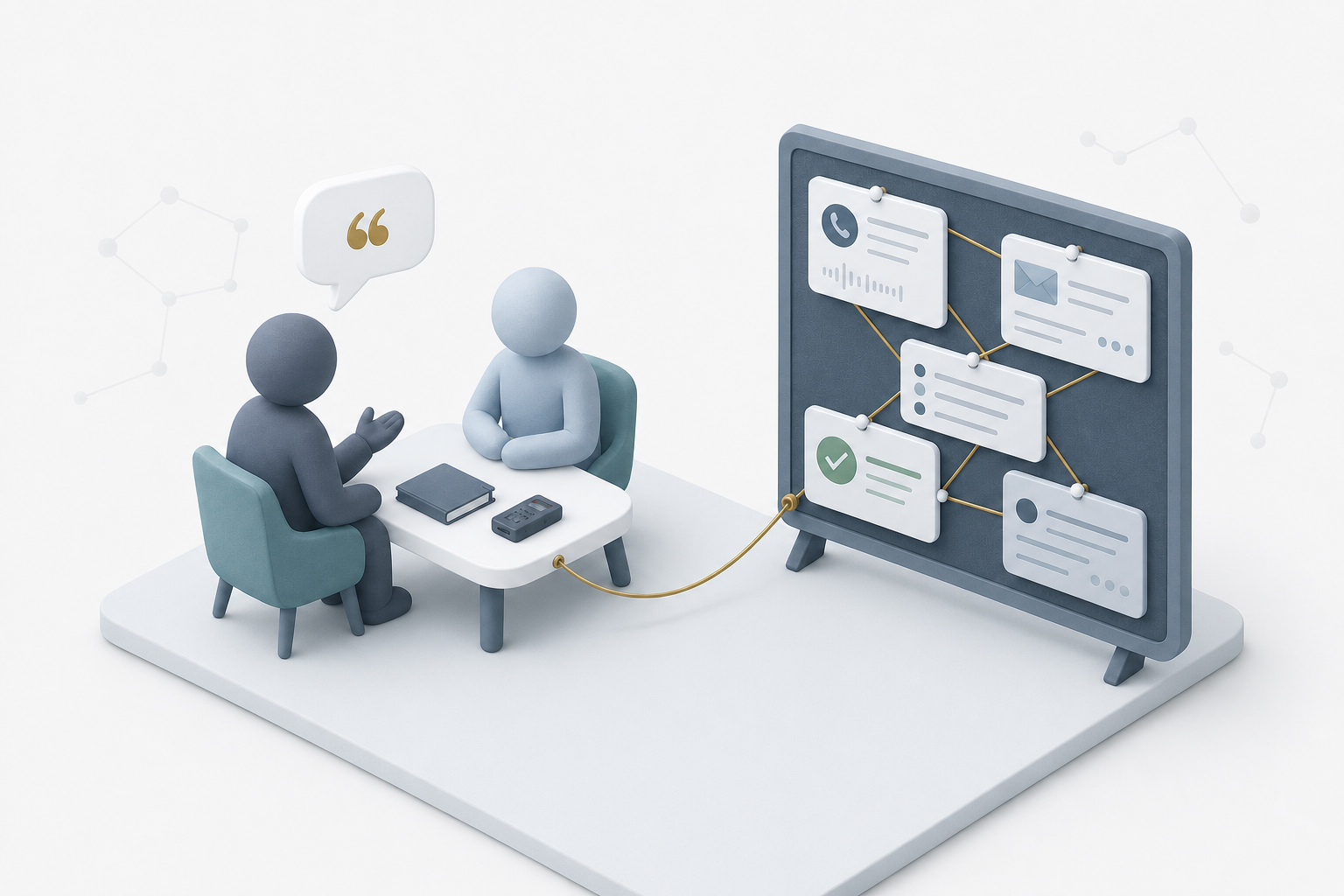
The intelligence world learned this a long time ago, at some cost. A single human source is never reported as fact. People misremember, they reconstruct events to fit what they now know, and they shade the account toward whoever is asking — usually without any intent to deceive. So a human source is corroborated: ideally against another human source with a different incentive (the buyer has no reason to protect your rep’s number), and better still against an objective record that has no incentive at all.
Win/loss has both kinds of source available and usually reads only the biased one:
| Human sources (biased by design) | The objective record (a truer log) | |
|---|---|---|
| What it is | Rep debrief, buyer interview, the CRM note written from memory | CRM activity data — timestamps, stage changes; call recordings; the email and correspondence trail |
| Strength | Motivation, context, the "why" nobody logs | Sequence and timing that no one has to remember — it just happened, and it's on record |
| Weakness | Memory, incentive, audience — the account is edited before it reaches you | Tells you what happened, rarely why; needs a human read to interpret |
This changes what an interview is for. Its job is reconstruction, not verdict. You are not asking the buyer to hand you the loss reason; you are asking them to help you rebuild the timeline, which you then check against the record. “When did the front-runner change, and what was happening right before that?” produces something you can corroborate. “Why did we lose?” produces a verdict you have to take on faith.
And the most valuable moment in the whole program is when the two disagree. Contradiction is the signal, not the noise. When the buyer says one thing and the email trail says another, you have found the exact place to think hardest — and, more often than not, the record is the more believable witness.
A pattern I see repeatedly: the rep logs “lost on price.” The buyer, in the interview, confirms it — “you were the expensive option.” But the correspondence trail tells a different story: the buyer’s technical lead went quiet for eleven days right after the security-review round, and the thread never recovered its momentum. Price was the account everyone could comfortably agree on afterward. The security stall was the decision. Only the record could have surfaced that, and only a human read of the record could have made sense of it.
What does a redesigned program look like?
Start from the decision the program serves — the same question-first discipline that applies to any research effort — then choose sources and timing to reconstruct the decision and corroborate it, not to collect a single retrospective story.
| Design choice | Standard default | Redesigned |
|---|---|---|
| Who is asked | The sales rep; one buyer contact if available | More than one seat: rep, plus the buyer, and where possible a second buyer-side voice (champion, economic buyer). Different incentives, cross-checkable accounts. |
| When | After close, once | As close to the decisive window as access allows — and for strategic deals, checkpoints during the evaluation, not only after it. |
| Who asks | The rep or their manager | Someone neutral — a third party or an internal team outside the sales chain. Buyers edit less when the interviewer has no stake in the answer. |
| What is asked | "Why did we lose?" | "Walk me through the evaluation — when did the front-runner change?" Reconstruction questions, not verdict questions. |
| What else is read | Nothing — interviews only | The objective record: CRM activity data, call recordings, the email trail. Corroborate the interview against it, and think hardest where they disagree. |
Two honest boundaries.
Not every company can keep that record. Consent laws, regulated industries, data-retention limits, and privacy regimes mean many firms cannot record calls or hold correspondence tied to a deal — for good reasons, not negligent ones. If that is you, the objective-record leg is simply not available, and the answer is to lean harder on the other kind of corroboration: more than one human source, deliberately chosen for different incentives, so no single account stands alone. This redesign degrades gracefully; it does not require surveillance.
But if you can keep the record and you don’t, that’s the real miss. Interview-only programs are expensive and slow — which is exactly why the vendors who sell them champion the buyer interview as the ultimate source of truth. It is a source of truth. It is also the most biased one you have. Leaving an available, near-objective record unread while paying a premium for human intelligence alone is the win/loss equivalent of interviewing a witness and ignoring the security footage.
Feasibility, briefly: buyer participation is more attainable than teams assume — Clozd commonly sees participation rates of 15–30% for buyer interviews, against 3–5% for surveys. And there’s real room to act: in Corporate Visions’ buyer data, 53% of buyers said the losing vendor could have done something differently and won.
What can you fix this quarter?
Four changes cost almost nothing and don’t require a vendor:
- Separate the rep debrief from the buyer research. Keep debriefing reps — for process visibility, not for loss attribution. Never let the CRM dropdown be the system of record for why.
- Change the questions from verdicts to timelines. “When did we lose the lead position, and what was happening then?” asks the buyer to reconstruct, not to justify.
- Read the record alongside every interview. Where you’re able to keep one, pull the interaction trail for the deal and lay it next to what people told you. Treat the disagreements as the finding, not an error to reconcile away.
- Move the asking out of the sales chain. A neutral interviewer — even just someone from insights or product — changes what buyers are willing to say. If you can’t remove the sales chain entirely, at minimum stop having the account’s own rep run the interview.
If you take one thing from this post: a win/loss program is an intelligence operation, and no serious intelligence operation runs on a single biased source. In the programs I’ve reviewed, most lean almost entirely on one — and no amount of interview volume fixes a design that never corroborates.
Win/loss is worth running. But run it as corroborated research into a decision, not as a ritual that produces clean, plausible, single-source data — the same false confidence problem that makes generic market reports feel safer than they are. The interviews are the easy part. Corroboration is where the truth gets in — or doesn’t.
Want an outside review of your win/loss design? Let’s talk.
Sources
- Clozd, “5 Lies Your CRM Is Telling You About Your Buyers” — 1,000-deal CRM-vs-interview comparison (15% match, 44% outcomes-as-reasons).
- Clozd, “What ‘Your Price Is Too High’ Really Means” — the “very rarely” a raw price difference finding — and “Communicating Price” — what the price answer stands in for.
- Clozd, “The Ultimate Guide to a World-Class Win-Loss Program” — participation benchmarks (15–30% interviews vs 3–5% surveys).
- Corporate Visions / Primary Intelligence, “Win/Loss or Win Rates?” — 100,000+ B2B deal evaluations (70% seller-buyer divergence; 53% winnable).
- Anova Consulting, “Beginning a Win Loss Program” — the 40% / 28% / 32% candor breakdown.
- CEB / Google, “The Digital Evolution in B2B Marketing” (2012) — the original “57%” study, n=1,500.
- Gartner, “The New B2B Buying Journey” (archived 2023) — 17% of buying time spent meeting suppliers.